
 nisha kittles
Perspectives / Creative technology
Beyond the Deck:Rethinking How Creative and Marketing Teams Work
Exploring how AI, Figma, and creative technology are changing the way we work, what we create, and the roles we play.
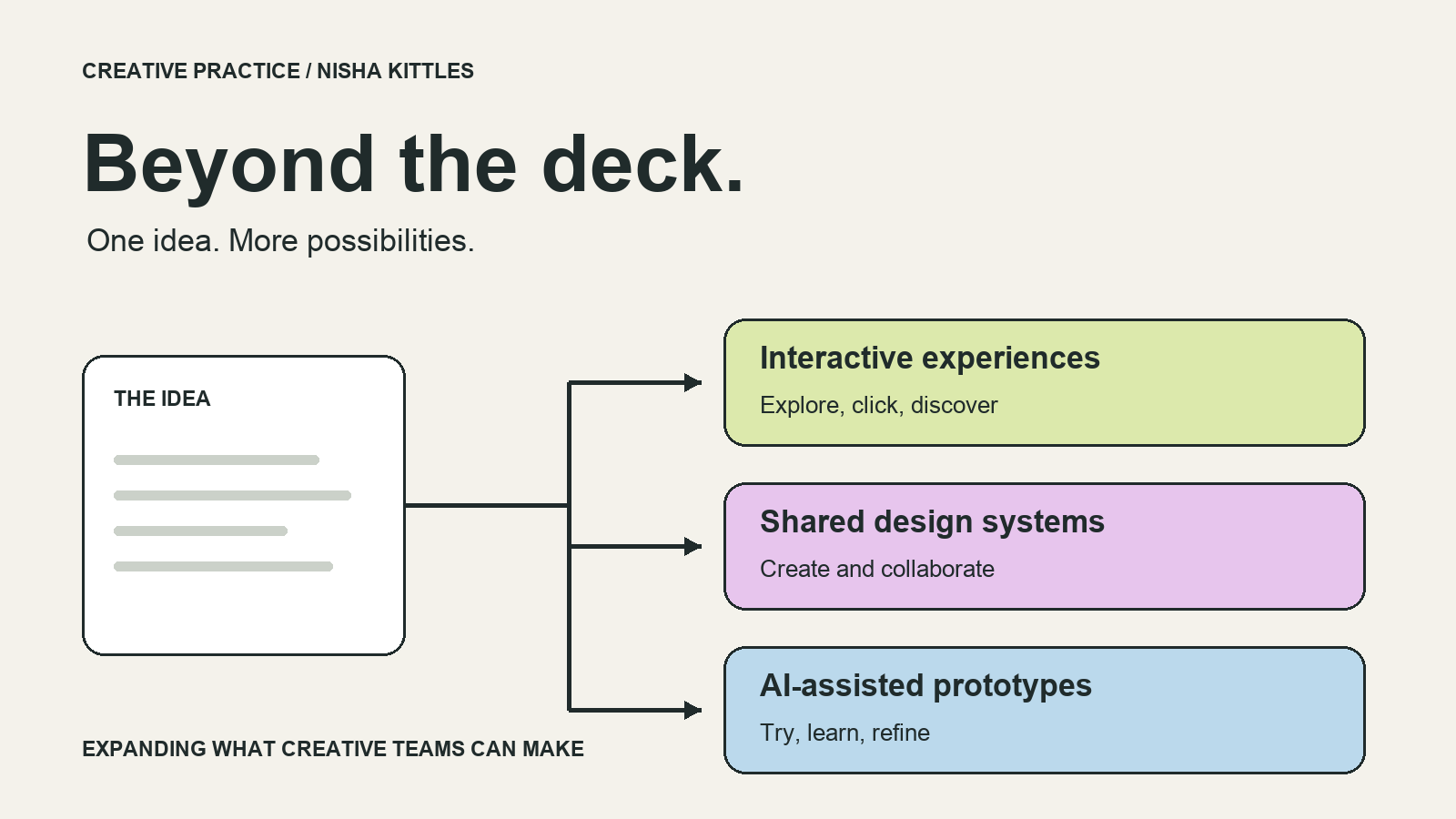
I’ve been thinking a lot lately about how much the creative industry is changing, especially inside large enterprise organizations.
As a designer and art director, I’ve spent years working with marketing teams, building campaigns, developing creative assets, managing brand standards, and figuring out how to make the creative process more efficient.
And one thing I’ve started questioning more and more is why we’re still doing so many things the same way.
We have all these incredible new tools, AI capabilities, and creative technologies available to us, but somehow we’re still spending days building PowerPoint presentations, exporting PDFs, creating endless variations of the same assets, and passing files back and forth for revisions.
Don’t get me wrong. There’s absolutely a place for those deliverables, and I still use them. But I think we’re at a point where we should start asking ourselves whether they’re always the best solution.
Because sometimes, they really aren’t.
Why Does Everything Have to Be a PDF or PowerPoint?
This is probably one of the biggest questions I’ve been asking myself lately.
Let’s say we’re creating a training guide, a product presentation, or a sales enablement piece. Traditionally, we’d develop a deck or PDF, go through rounds of design and review, package everything up, and distribute it.
But what if that same content could be an interactive experience instead?
What if the audience could click through a product demonstration, explore information at their own pace, watch animations, interact with data, or even get personalized answers to their questions?
And what if we could create a working version of that experience in significantly less time than it would traditionally take?
With AI-assisted development, rapid prototyping, and the growing capabilities of tools like Figma, these possibilities are becoming much more accessible.
I’m not saying we should stop creating presentations or PDFs. Sometimes those are exactly what the audience needs. They’re portable, familiar, and easy to distribute.
I’m saying we should stop automatically assuming they’re the only options.
We have an opportunity to rethink what the final creative output could actually be.
I Think Figma Has a Much Bigger Role to Play in Marketing
One area I’ve been exploring is how Figma can become more integrated into the everyday workflow of marketers, not just designers.
Traditionally, marketers create briefs, develop messaging, and send things over to the creative team. Designers build the assets, marketers review them, changes are requested, and the cycle continues.
I’ve worked in that process for years.
And while it works, it can also be incredibly time-consuming, especially when you’re dealing with enterprise brands, multiple stakeholders, and large volumes of deliverables.
What interests me is how we can bring marketers closer to the actual creation process.
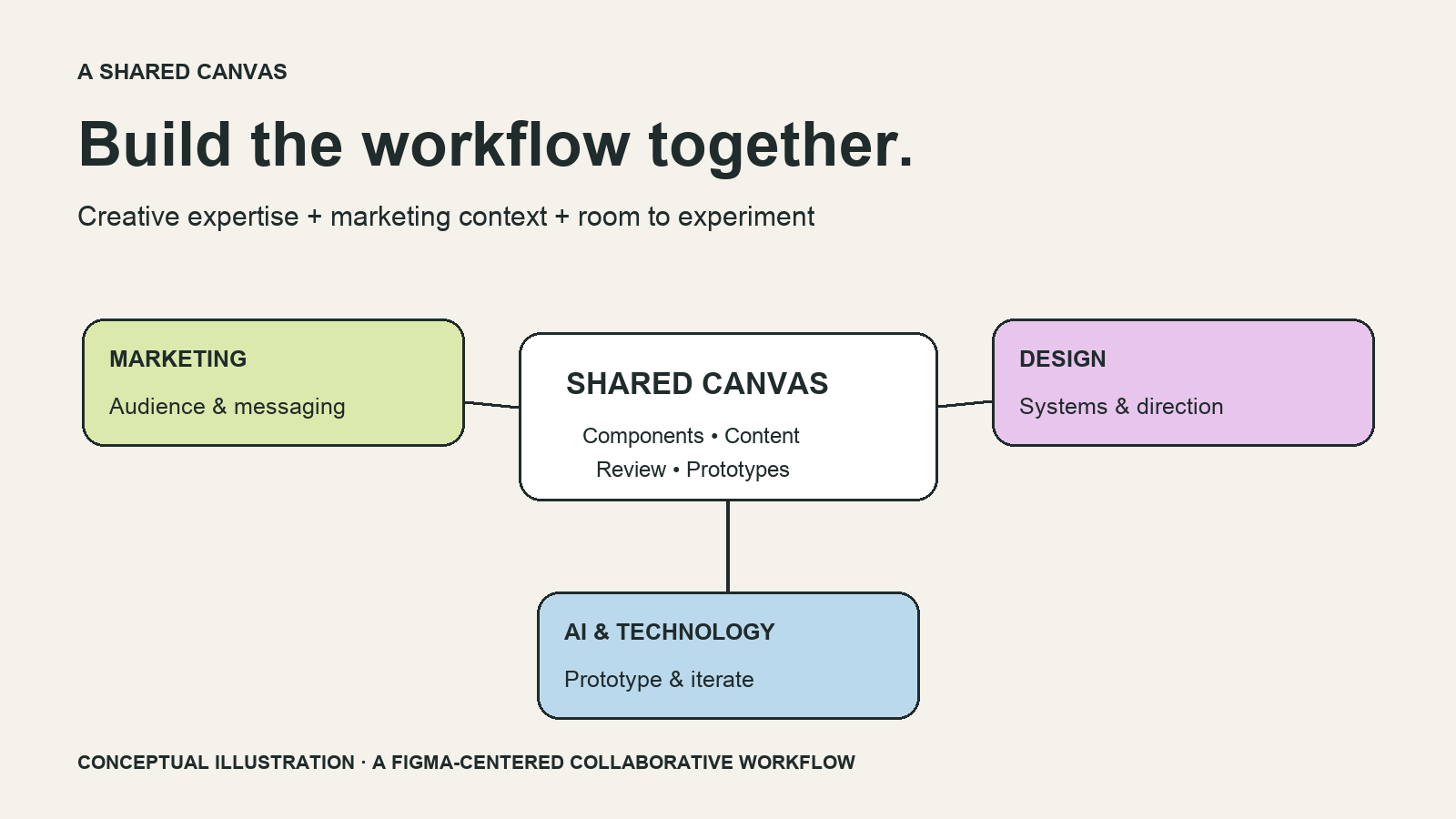
Figma is already a collaborative platform, but when you start combining design systems, reusable components, prototyping, and AI-assisted workflows, the possibilities expand.
Marketers can participate in developing content, exploring layouts, reviewing experiences, and even assembling certain types of approved assets within established brand systems.
Imagine a marketer being able to create a first draft of a campaign landing page, preview an interactive concept, or update messaging directly inside a controlled design environment.
Now imagine that happening without a designer having to rebuild the same layout five different times.
For me, that’s exciting.
It doesn’t mean marketers are replacing designers. It means we can start designing smarter workflows where everyone contributes more effectively.
Of course, there’s still the question of governance. Enterprise brands need consistency, accessibility, quality control, and clear approval processes.
That’s where thoughtfully built design systems and creative leadership become even more important.
The opportunity isn’t just giving more people access to design tools. It’s building an environment where they can use those tools responsibly and effectively.
Creative Roles Are Changing, and I Think That’s a Good Thing
I’ve also been thinking about how all of this changes our roles.
What does it mean to be a designer when AI can generate layouts, assist with production, write code, and help build interactive experiences?
What does art direction look like when creative teams can prototype ideas almost as quickly as they can imagine them?
And what happens to traditional production roles when repetitive tasks can increasingly be automated?
I don’t think these questions should automatically make us nervous. I think they should make us curious.
Personally, I see my own role continuing to expand beyond traditional art direction.
I’m still a designer. I still care deeply about typography, composition, visual storytelling, branding, and all the details that make great creative work great.
But I’m also thinking more about systems, automation, technology, user experience, and how different platforms can work together.
I’m interested in creating the workflow, not just the deliverable.
For example, I’ve been exploring ways to scale digital creative production through connected design workflows, automate repetitive tasks, and use AI to move ideas into prototypes much faster.
That changes the kind of problems I get to solve.
Instead of spending all my time figuring out how to produce 50 variations of an asset, I can spend more time figuring out how to build a system that supports those variations.
Instead of only designing a presentation, I can explore whether the information would work better as an interactive tool or digital experience.
And instead of thinking only about the next campaign, I can think about how the entire creative process could improve.
I think we’re going to see more designers moving into roles that combine creative direction, experience design, AI, automation, and technology.
And I think marketers will evolve too, becoming more involved in the creative process as tools make certain capabilities easier to access.
It doesn’t eliminate the need for creative expertise. In many ways, it makes that expertise even more valuable.
AI Is About More Than Doing the Same Work Faster
A lot of the conversations I hear about AI in marketing are focused on saving time.
How can we generate more content? How can we produce more assets? How many hours can we eliminate from the process?
And yes, efficiency matters. Especially when you’re working at enterprise scale.
But I’m much more interested in what happens when we use that saved time to explore something different.
What new experiences can we create?
What ideas have we been putting aside because they were too expensive, too complicated, or required too many resources?
What could a small creative team accomplish today that would have required an entire production team a few years ago?
Those are the possibilities I find exciting.
I’ve been experimenting with AI-powered creative workflows, digital experiences, and ways to connect design tools with other technologies.
Sometimes it’s about accelerating production. Other times it’s about creating something entirely different from what I originally imagined.
And I think that’s an important distinction.
AI shouldn’t just help us create more of the same things. It should give us the freedom to try new things.
That doesn’t mean every experiment is ready for production, or that everything AI generates is good. There’s still a lot of testing, refinement, and human judgment involved.
But being able to explore more ideas, build working concepts faster, and test different approaches without the same level of upfront investment is a pretty big deal.
Enterprise Marketing Has Some Catching Up to Do
Here’s where things get interesting.
Large organizations have spent years building processes around specific deliverables, tools, departments, and approval structures.
And those processes don’t suddenly change because a new technology becomes available.
You can introduce AI into an organization, but if everyone is still working through the same disconnected systems and unnecessary handoffs, how much have you really changed?
I think the bigger opportunity is rethinking the workflow itself.
Maybe that means bringing Figma further into the marketing process.
Maybe it means creating shared design systems that allow teams to produce certain assets independently.
Maybe it means building interactive digital experiences instead of static documents.
Or maybe it means using AI and automation to handle repetitive production tasks so creative teams have more time for strategy, exploration, and problem-solving.
In my experience, creative transformation works best when we’re thinking about the people, the process, and the technology together.
It’s also important to recognize that not every organization is ready to move at the same pace. Enterprise teams have real requirements around security, accessibility, compliance, brand integrity, and maintainability.
Those things matter.
The goal should be to introduce new capabilities in ways that make the work better, not simply more complicated.
So, What Does the Future Look Like?
I don’t have all the answers. And I don’t think anyone does right now.
Technology is moving incredibly fast, and we’re all figuring out what these changes mean for our industries and our careers.
But I do think we’re going to see a significant shift in how enterprise marketing and creative teams operate.
I see more collaborative workflows where marketers, designers, strategists, and technologists are working together much earlier in the process.
I see designers becoming more involved in building systems and experiences instead of only producing individual assets.
I see AI making experimentation and development more accessible, allowing teams to explore ideas that previously felt out of reach.
And I see organizations starting to question whether some of the deliverables we’ve relied on for decades are still the most effective way to communicate.
For me, the most exciting part is the expansion of possibilities.
I love design. I love the creative process. And I love the challenge of figuring out how to communicate something in a way that’s clear, engaging, and visually compelling.
Now I get to explore how technology can help me do that in completely different ways.
I’m not interested in replacing creativity with AI. I’m interested in seeing how far creativity can go when we remove some of the barriers that have traditionally limited it.
And I think that’s a conversation more creative and marketing teams should be having.
Maybe instead of asking how we can make the next deck faster, we should start asking whether we need a deck at all.
Please excuse any mistakes. I’m a creative designer, and as much as I love AI, I wanted this to be in my own words. 🙂
Nisha
Explore what’s possible.
Creative technology, connected workflows, and design in practice.